The young and supernally promising American guitarist Evan Taucher is part of a generation that has generally been more responsive to my music than the preponderance of coevals with whom I made the erstwhile choice to incarnate. He has graciously accepted the dedication of my op. 83 sight unseen, although he is understandably eager to attain such sight. But engraving it properly for distribution is work I would want to be doing on my iMac, whose keyboard will have to be replaced. A new one is on the way, but I am consigned meanwhile to this laptop, where audio work comes more comfortably than any visually centered enterprise.
I took advantage of this interregnum yesterday, and made sample files for inclusion here to illustrate the music I had described so far in earlier blogs. Since I have not really talked in depth about anything since Variation 3, it will behoove me to provide more backstory from here on out. Nonetheless, today is Evan’s birthday, and I aim to finish providing annotated audio samples through to my new opus’s last measure. Ironic that Evan will get to hear this preview of the music to the end before he actually sees it, but there it is!
My Contrasts for woodwind quintet (op. 34) contains its own set of variations. My lineage is half Italian and half Irish, reflected as that number’s dour siciliano is followed by an extrovert bagpipe tune straight out of the British Isles. (I know that it has lately become politically incorrect to subsume Ireland within that designation, but since my Frost forebears hailed from County Clare, I feel safe enough!) In the blog E3 below I pride myself on never repeating myself, but I went on to do just that when I got to Variation 4! More drone, more exultant wailing (here from Guitar 1) on top. The key is C major (relative major to A minor, the key of the dolorous Variation 3 we have just left). At the end here of Variation 4, a transitional passage is bringing us back home to the key wherewith everything started, namely F major.
The literature is filled with references to creative people saying that such-and-such work got, exceptionally, out of their hands. In my case, this has been true for virtually everything I ever composed! Case in point. I knew from the get-go that I wanted to cap my variations with a fugue, and ideas for such were brewing all along as I was working out the less rigorously contrapuntal variations you have heard thus far. When I was still using my iMac, I prepared a proper engraving of just the first page to my score and shared it with Evan, so that he could see the dedication up on top. Although the fugue was, at the time, still but a twinkle in my eye (Happy Fathers Day, by the way, should that apply to you today…), I peremptorily included it in the work’s title, right under the dedication.
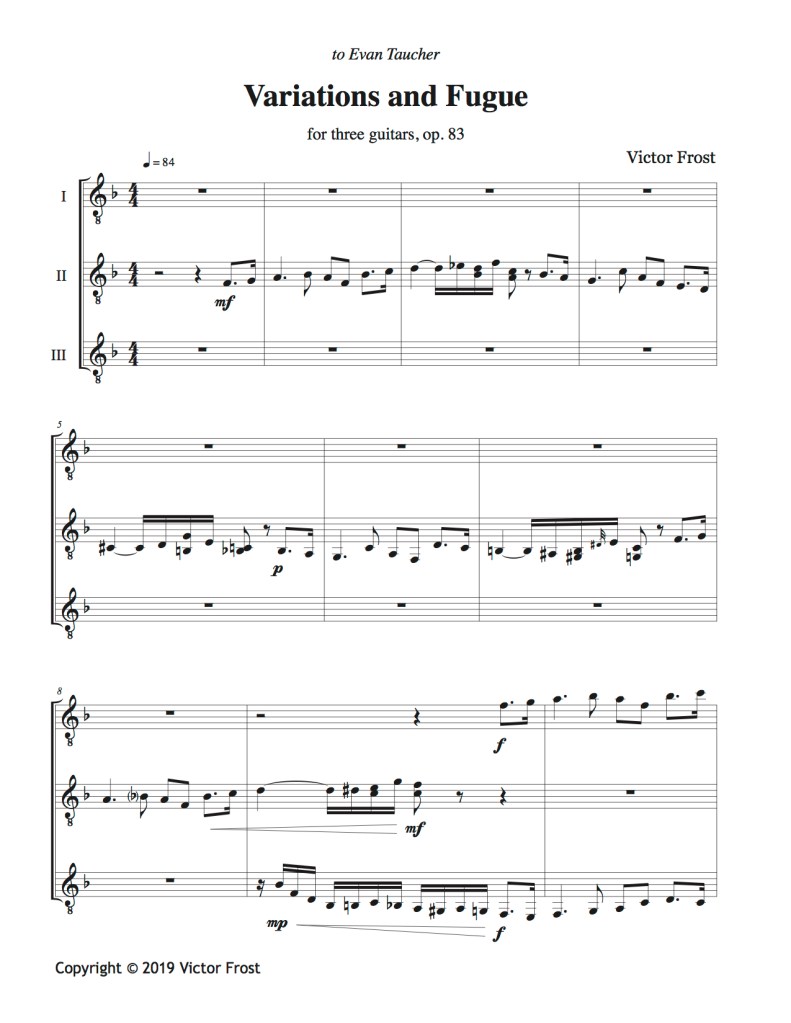
All I had to do was wait until I had made my way back ’round to the opening key, and that is where I now found myself at last! But the fugue I was so eager to write had to wait, it seemed, for one more, altogether unanticipated, variation! My op. 79 is a set for two guitars, some of which has been performed and even recorded, but not yet the crisp finale, which I called Minstrel Show. (Nigerian guitarist Taiwo Adegoke has asked permission to do so, so I have something to look forward to. It would be the first performance of my music I would be aware of on the continent, outside of South Africa.) In op. 79’s concluding duo, the top guitar part lies quite high, in imitation of its five-stringed cousin, the banjo. The composer who so abhors repeating himself, yes, did so again here, and this time with a work from just last year! Sigh. So, crowding out the impatient fugue, here is my minstrel variation, no. 5! (Guitar 3 has the throwback melody throughout, balancing as it were the doleful aria it intoned in the third variation.)
Guitar 2, which alone presented the perky tune I woke up hearing now ten mornings ago, also ushers in the fugue. Followed by Guitar 1. The fact that Guitar 3 then comes in last ends up being of structural importance later. The exposition.
Guitar 1, though, gets the last word as is usual, in an augmentation of the tune’s first six notes, followed by a six-string cry of joy from all three instruments!
I would love to end here, but I predict that my inbox would get filled with complaints that I hadn’t presented the work entire. Here is where the misgivings I bespoke in the opening paragraphs of yesterday’s blog are felt most keenly, and I wished I could have the first public presentation of op. 83 be a real and not synthetic performance. But I yield to circumstance in the interest of seeing this series, the S that is to say in the (S1/E8), to its close. S2 will involve the composition’s public facing, to whatever extent it gets one in an admittedly crowded field. (I really do understand, and that is why I maintain such sincere friendships with musicians who do not choose, for whatever reasons they might have, to program my music.)
And so, it is ironic on this Fathers Day that I say of these fragments, quoting the old song, “Put them all together, they spell M-O-T-H-E-R.” But I’ll say finally, with optimism, here’s to having lots to say in that S2 waiting there in the wings!
 Victor Frost's Online Chronicles