Today I finished engraving the last scene of my opera’s first act. That leaves just one to do, but it’s the whopping Scene 2 from the same act. It’s 36 minutes long; that is to say, longer than Scenes 3 and 4 combined!
I am doing this close work in terms of both engraving the music and preparing the NotePerformer mock audio for use by those studying the opera for performance. In this day and age I will be eschewing the traditional piano reduction (except possibly in the few scenes that feature chorus) in favor of scrolling score videos. I frankly admit that the ability to also share these resources with family and friends, while heartening, is essentially a by-product of my ongoing promotional activities.
Eventually, everything will be on video in both of two forms. Individual scenes will be of greatest interest to performers and certain opera company personnel. Those have detailed synopses with corresponding timings to help facilitate musical and dramatic preparation. Most of my followers, though, just want to hear the music, see the lyrics as they scroll by, and possibly pause the video to take in the stage directions in the score from time to time. For them there will be three more substantial chunks.
Working backward, the third chunk is the second act (of two) complete:
The individual videos for the scenes from Act II are up on Vimeo, q.v. Scene 3 from Act I is already out as well, but a separate video for Scene 4 will take a bit more work before it could be of use to cast, crew and directors. (Ultimately, only Vimeo will be housing the individual scene videos. It has a Chapter index feature I have been exploiting to abet preparations for the opera, particularly the synchronization of events in the libretto with specific moments in my score.)
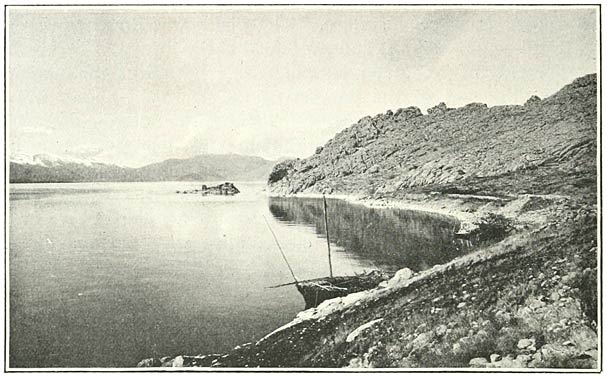
A strand like this one, on the coast of Akhtamar Island, is the setting for Scene 4 in Act I as well as Scene 2 in Act II.
(The first chunk has to wait until I engrave Scene 2 of Act I. Gulp!)
Writing the evening-long opera took less than a year, to the great surprise of many, including the composer! In an exchange typical of Facebook, my sister-in-law’s congratulations included a dig about my new home’s still-unpacked boxes; the retort after my LOL emoji was that many would undoubtedly be lying around anyway, opera or no!
On the one-year anniversary of starting work on my opus 91 (May 25th), I decided to repost my Facebook entry marking the date here, as S3/E1. Eventually everything there worth keeping will migrate similarly to this more appropriate forum. Recall that in E2 I mentioned that certain folks in my circle could not be prevailed upon to click on a Facebook link, for love or money! For everyone’s convenience I will provide here all the resources that clicking on E1 would avail, which puts us all on the same page.
This explanatory text (from June 13, 2022) that introduced the audio sample linked below was, in fact, my first public message anywhere regarding the project:
“For a while I have had the text for an opera fashioned by a British librettist. Set in medieval Armenia, he sent it to me in three versions, engendering quite a muddle! On May 25th I settled upon which iteration of the first scene I would be setting. Out of my subconscious emerged this bit of exotica, which left no doubt to what use I was supposed to put it. I finished that first scene today, ten minutes of music in complete orchestral detail, and wanted to mark the occasion before collating now the versions of Scene 2. God be with me. We begin with a fanfare announcing the entrance of the local feudal overlord.”
A lot of friends and colleagues wished me well, but this comment from Jonathan Clift, the Bradford-based librettist, had to be the most heartening:
“I am knocked sideways! Thank you! it has such melody and at the same time there is a mediaeval/strange feeling to the music thta sets it nicely in Armenia bravo!!”
Similar snippets that accrued in real time as the project progressed, however, were effectively superseded by audio of the first scene entire, once it was finished. This then evolved gradually into a definitive listening version, as I attained greater and greater mastery of the NotePerformer plug-in which had recently been released for the Finale music software I use. Eventually even that would be displaced: by a scrolling score video, as have most (but not yet all at this writing) of my opera’s other scenes. The advantage therein, even for those who don’t read music, is that you can see the lyrics being sung and take cognizance of the stage directions. (A side comment: “This first scene is Music B because A is a short choral-orchestral Prelude I would write later.”)
This WordPress blog began in that singular year 2019 at the inception of my op. 83, a work for three guitars, which ended up being my sole composition that year. In S1/E2, I wrote “I thought I might mark the occasion in real time on my Facebook page, but as I gathered my thoughts I realized that they would have strained that particular medium.” Alas! I lost touch with this insight last year at the tail end of pandemic restrictions being imposed by either self or society. So many of us were using social media to keep in touch even with family and nearby friends and acquaintances that it made concentrated work on blogging seem impersonal and exclusive.
The present S3 will mostly represent a course correction in which the many blog-like entries interpolated into my Facebook profile regarding the development of my op. 91 opera are tidied up here, where they belong! On social media I get the full range of readers, from those who have little interest in my composer’s career to those who have little else. At this point the Facebook material about the opera is hard to access among all my other many posts, and besides, some of my followers eschew the social media giant altogether.
S1 was complete in itself, a good chronicle of the guitar trio from its very inception to the finish line, and its musical examples well illuminated the fine points I wanted to underscore.
S2 was supposed to have been about the work’s making its way into the world. After an initially auspicious reception we hit the mural (as in wall-like) pandemic. With lives being lost, careers being shattered, groups and ensembles broken apart, I regarded it (correctly) as self-indulgent to whine about the fate of my trio no-one had asked for. (I recall poignantly ruing a red-letter day on Facebook when a big orchestral work of mine had been slated for performance by a major French orchestra. I decided to put up a recording of it from a few years earlier, and explained how it was brought to mind after I took notice of the date. I was roundly criticized for this; that’s how bad things were.)
So, after a certain, frustrating point nothing seemed appropriate to be blogging about here and S2 remained incomplete, unrealized. It’s possible that my failure to return here when I decided to do something similar with the opera was owing to the chagrin I retained from that episode in my life. But a life lesson I have managed to learn is always to use the best tool for a given job. And this forum is indeed the best way to interact with those who want to know something about Akhtamar and its origins.
In my last blog I discussed the necessity to forge program notes for the new opus, at which point I would be done creatively with the work. Today, I prepared such notes to my satisfaction.
All that remains now is for me to finish churning out the three parts, for then I will be in a position to share the work with any interested group. (A few, knowing I had works for one, two, and four guitars, had made inquiries. These will obviously be the ones I share the new trio with first!)
I have finished engraving the reference score of my new trio. No-one will ever perform from it (each of the three players would have an individual part), and probably very few will ever make “reference” to it as such, but it is vitally important nonetheless. One good thing is that, in the age of music processing, files for the parts are generated from the full score, like the one I completed today. So, much of the work that went into making it look good will carry over into those performing parts.
I am in an unprecedented position owing to this real-time blog. At this point I would usually prepare some program notes for any new composition, while the experience was still fresh. And yet, most or possibly all of what I would want to say about the music and its genesis is likely to be found in the entries below. So I will review them from the beginning and distill what I read into some formal notes. That involves not just concision, but adopting the right tone for readers unfamiliar with me or the better part of my output.
Here is a link to the opus’s public folder. Its name will not change over time, but its contents will (such as the addition of parts). Right now, the score, for those of you who read such, and the promotional audio sample.
When I retired to Baltimore, there were some neighborhoods I knew better than others. I played it safe, and chose the one I knew best, the cultural district. That encompasses roughly the northern end of Mt Vernon (no one uses concluding periods here; I live on Hunter St) and most of Midtown-Belvedere. (I don’t know whether the splendid art deco hotel gets it name from or gave its name to the area; I only know I am still wowed by it every time I walk by.)
I found a place halfway between Meyerhoff Hall (where the Symphony plays) and Peabody Institute (where, among other luminaries, the leonine guitar master Manuel Barrueco holds court). A townhouse that was originally a carriage house, which means that it came with a huge garage that I didn’t need. Indeed, I specifically chose this neighborhood from among the ones in Baltimore where a car wouldn’t be needed!
But it meant that I could extend a hand of hospitality in a way that was never possible in all those decades I had lived in New York City. The secure garage and a well-appointed extra bedroom with ensuite bath have made my place something of a pit stop for those driving (up and down Interstate 95) or flying (connecting to and from Europe internationally, or Eastern Seaboard destinations locally) through.
One person driving through recently, who wanted to break up his trip south to visit family, was guitarist Peter Fletcher. My op. 57 Ten Miniatures (solo guitar) are dedicated to him, a gesture of thanks for his championing my music, including this performance of my guitar concerto. (I don’t capitalize there so I can ignore the official title with which I fear I am stuck after all these decades: Concertino!)
As it happened, this was the same day last week I finished my trio! Fortunately, I did bring the work to completion before he actually arrived at my door, but I was, how you say?, burned to a crisp, folks. If I was less than coherent in my interactions with him, my old friend did not seem to mind! (Or in his Southern gentility was too polite to betray having noticed.) As he was preparing to shove off the next morning, he thanked me for my hospitality, but I immediately thanked him in turn “for bringing me back to earth!”
Meanwhile, I of course mentioned to him the day’s breakthrough in my life. So that, in the midst of the de rigueur tour, when we got to my office I played back the newly minted scrolling score on my computer from the Finale program. That means that he heard the same representation of the music as I appended to the bottom of yesterday’s blog, but could also see the score as it scrolled by. That makes him the only guitarist to have laid eyes on it yet.
He expressed great enthusiasm, remarking how beautiful some passage was as the scroll inched by. He offered to record it then and there. Of course he meant, that he would lend his services if I could scare up two supplementary players. In my embarrassment, though, I pretended not to understand that, and protested, “but Peter, you can only play one guitar at a time!”
I include this anecdote so as to justify my optimism regarding Variations and Fugue’s future. Things are clearly off to a good start.
The young and supernally promising American guitarist Evan Taucher is part of a generation that has generally been more responsive to my music than the preponderance of coevals with whom I made the erstwhile choice to incarnate. He has graciously accepted the dedication of my op. 83 sight unseen, although he is understandably eager to attain such sight. But engraving it properly for distribution is work I would want to be doing on my iMac, whose keyboard will have to be replaced. A new one is on the way, but I am consigned meanwhile to this laptop, where audio work comes more comfortably than any visually centered enterprise.
I took advantage of this interregnum yesterday, and made sample files for inclusion here to illustrate the music I had described so far in earlier blogs. Since I have not really talked in depth about anything since Variation 3, it will behoove me to provide more backstory from here on out. Nonetheless, today is Evan’s birthday, and I aim to finish providing annotated audio samples through to my new opus’s last measure. Ironic that Evan will get to hear this preview of the music to the end before he actually sees it, but there it is!
My Contrasts for woodwind quintet (op. 34) contains its own set of variations. My lineage is half Italian and half Irish, reflected as that number’s dour siciliano is followed by an extrovert bagpipe tune straight out of the British Isles. (I know that it has lately become politically incorrect to subsume Ireland within that designation, but since my Frost forebears hailed from County Clare, I feel safe enough!) In the blog E3 below I pride myself on never repeating myself, but I went on to do just that when I got to Variation 4! More drone, more exultant wailing (here from Guitar 1) on top. The key is C major (relative major to A minor, the key of the dolorous Variation 3 we have just left). At the end here of Variation 4, a transitional passage is bringing us back home to the key wherewith everything started, namely F major.
ex. 9
The literature is filled with references to creative people saying that such-and-such work got, exceptionally, out of their hands. In my case, this has been true for virtually everything I ever composed! Case in point. I knew from the get-go that I wanted to cap my variations with a fugue, and ideas for such were brewing all along as I was working out the less rigorously contrapuntal variations you have heard thus far. When I was still using my iMac, I prepared a proper engraving of just the first page to my score and shared it with Evan, so that he could see the dedication up on top. Although the fugue was, at the time, still but a twinkle in my eye (Happy Fathers Day, by the way, should that apply to you today…), I peremptorily included it in the work’s title, right under the dedication.
All I had to do was wait until I had made my way back ’round to the opening key, and that is where I now found myself at last! But the fugue I was so eager to write had to wait, it seemed, for one more, altogether unanticipated, variation! My op. 79 is a set for two guitars, some of which has been performed and even recorded, but not yet the crisp finale, which I called Minstrel Show. (Nigerian guitarist Taiwo Adegoke has asked permission to do so, so I have something to look forward to. It would be the first performance of my music I would be aware of on the continent, outside of South Africa.) In op. 79’s concluding duo, the top guitar part lies quite high, in imitation of its five-stringed cousin, the banjo. The composer who so abhors repeating himself, yes, did so again here, and this time with a work from just last year! Sigh. So, crowding out the impatient fugue, here is my minstrel variation, no. 5! (Guitar 3 has the throwback melody throughout, balancing as it were the doleful aria it intoned in the third variation.)
ex. 10
Guitar 2, which alone presented the perky tune I woke up hearing now ten mornings ago, also ushers in the fugue. Followed by Guitar 1. The fact that Guitar 3 then comes in last ends up being of structural importance later. The exposition.
ex. 11
A lot of composers have written variations topped off with thematic fugues, but they usually use only the head material from the theme being treated, and let things just spin off from there. I chose, rather, to stick completely with my theme’s four-part structure, as outlined in yesterday’s blog, q.v. This is the reason that I allowed in E5 that the fugue could be doing double duty as a final, sixth variation. The exposition you just heard, then, would be A. I cannot reasonably separate B from B' in the next excerpt, but, short as it is, they are both there. In a good use of the trio of instruments, I begin with Guitar 1 imitated closely by 2 (B). When 3 takes over without pause, 2 carries on its imitative role (B').
ex. 12
In yesterday’s hairsplitting analysis I point out how, in each variation, the concluding A' can be heard to finish off in a way noticeably different from the opening A. This departure is taken to the hilt in this final panel to the concluding fugue. We have again the entrance of the guitars in order 2, 1, 3, but the last holds on to the reins, developing established materials into a climax in which the turns from its sombre third variation express, somehow, an impassioned optimism instead.
ex. 13
Guitar 1, though, gets the last word as is usual, in an augmentation of the tune’s first six notes, followed by a six-string cry of joy from all three instruments!
ex. 14
I would love to end here, but I predict that my inbox would get filled with complaints that I hadn’t presented the work entire. Here is where the misgivings I bespoke in the opening paragraphs of yesterday’s blog are felt most keenly, and I wished I could have the first public presentation of op. 83 be a real and not synthetic performance. But I yield to circumstance in the interest of seeing this series, the S that is to say in the (S1/E8), to its close. S2 will involve the composition’s public facing, to whatever extent it gets one in an admittedly crowded field. (I really do understand, and that is why I maintain such sincere friendships with musicians who do not choose, for whatever reasons they might have, to program my music.)
And so, it is ironic on this Fathers Day that I say of these fragments, quoting the old song, “Put them all together, they spell M-O-T-H-E-R.” But I’ll say finally, with optimism, here’s to having lots to say in that S2 waiting there in the wings!
If E6 had been given a subtitle, it would have been something like Glorious Inconsistencies. This one, more like Into the Weeds! I have decided to try illustrating my earlier text with musical examples. I have overcome some hesitation with regard to this matter. I am an old-school composer, and do not own DAW equipment, even though I could comfortably afford it. (What I couldn’t afford would be the bottomless rabbit hole it would involve in mastering some of those dauntingly arcane modern editing techniques!) I do not play guitar and do not, as it happens, have three players standing by to record the fragments that I have in mind!
All I do have is the capacity of my music processor (Finale) to play back the already notated music. This is enormously useful to me in two ways: as a proofreading tool, and in that it enables me to generate sample mp3 files to share with prospective performers. (My op. 80 is a set of ten studies for solo guitar. One of them involves 3 against 4 in a beat, and it was catching one performer up short. All she had to do was hear the audio file I had made and she was able to execute it flawlessly. The computer on which she played back my sample did the… computing for her!)
So the quality of the sound is not as sophisticated as we are accustomed to hearing even in synthetic recordings these days. Given that as caveat, here goes. (I will limit myself today to illustrating the text in E4, which you might want to review before going on. That is to say, the theme and first three variations.)
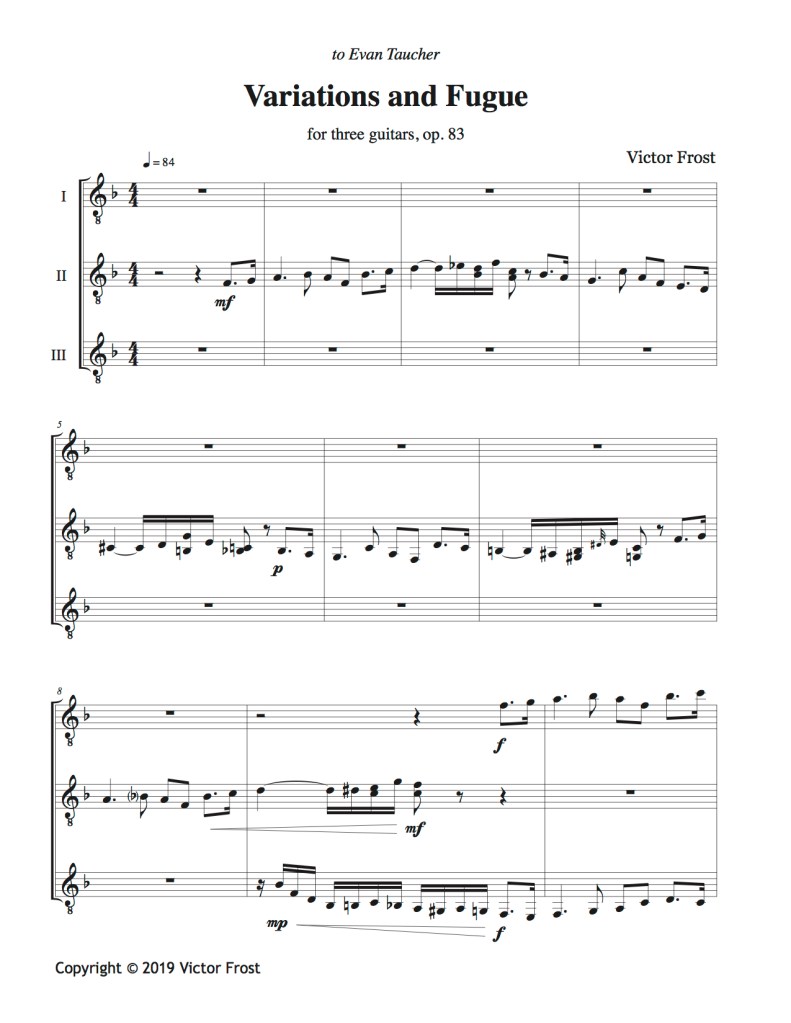
Here is the initial theme, as played by Guitar 2. I mentioned that it consists of four two-bar phrases, all in the same rhythm.
ex. 1
I can go further into the weeds. If A is the first phrase, and B is the second, the third could be called B-prime (B'), in that it is a variant on B. It begins the same, although an octave lower, but ends differently. Then the fourth and last phrase could be called A'. It again begins the same as A, even within the same octave, but ends differently in an exuberant final clinch.
Here is A.
ex. 2
And here is B.
ex. 3
Followed by B', which begins an octave below the preceding.
ex. 4
Finally we have A'. Its ending dovetails with the beginning of the first variation.
ex. 5
Variation 1. The theme is played an octave higher by Guitar 1, accompanied homorhythmically by 3.
ex. 6
Variation 2. A waltz played finally by all three instruments. At the end it spills over into a transition to the parallel minor, the key of Variation 3.
ex. 7
Variation 3 is dominated by turns in the melodic Guitar 3. Let me define that for non-musicians. Four notes. The main note is preceded by the note just above it; then, the one just below it, followed by the main note itself. Guitar 1 is limited almost exclusively to gestures in imitation of these turns. In its final one, it provides a link to the highly contrasting ebullience of the hornpipe over drones that is Variation 4. To be continued.
I’m back here sooner than I would have thought. I’m typing on my laptop now, because the keyboard I use on my big iMac suddenly stopped working! I ordered a new one, but until it arrives I will lack access to the desktop’s 27-in. screen. I really do need that to properly do the collating of my piece for strings (which I discuss in E5, and where I embedded a live performance should one care to listen) with the galleys the publisher sent me. Apologizing to him for my delay, I blamed it on the white-heat work I did on my spanking new guitar trio, which clearly did in the poor keyboard!
High among the perquisites to bloggery (as opposed to formal publishing) are the alibis inhering in the time/date stamp. You could have such temporal references in a book or magazine article, but someone would still be expected to take an overarching approach to the project and smooth out any inconsistencies in voice or facts among the various entries. On the contrary, no-one expects anyone to go back and tidy up a blog because it might contradict on Thursday what you typed on Tuesday! Each episode is self-contained and spontaneous and in this informal realm nobody keeps score!
I was rereading E4 when I realized that one could easily misread the first paragraph unless a comma was placed after the word “intervene.” Putting it in place after the blog date felt like cheating in a way. I am supposed to be chronicling in the moment, even if it be removed in time from what I am describing; these are supposed to be my thoughts at just that moment I find in which to type. If my desktop keyboard hadn’t chosen today to go south, the present moment whose memory I am pressing would not have been available! Such an arbitrary process, but arbitrary can have its appeals.
In E2 I imply that all-nighters are a thing of the past. Let me quote that most professional of composers, Britten.
“The old idea of a composer suddenly having a terrific idea and sitting up all night to write it is nonsense. Nighttime is for sleeping.” — Benjamin Britten
But in E5 I admit to an all-nighter after all. (I retired at about 3 A.M., but that was after getting up the previous day at 5 A.M.!) It wasn’t so much about an idea’s being terrific as my being terrified of going to sleep without working out a compositional snag that was simply refusing to be resolved. Needless to say, I finally collapsed into sleep willy-nilly, and was able satisfactorily to handle the intricate creative task the next day when I was fresh! Sigh.
Here’s another inconsistency my internal editor noticed, but which again I am allowing to stand in the interest of authenticity. (Or laziness….) In E3 I aver that composing is never easy, but in point of fact it does often seem that way when the flow is having its way with you and you do not resist. If asked to give a percentage of time that sense obtains, I’d say about 30. Anyway, then in the very next blog, E4, I say that for me writing waltzes is “as easy as falling off a log,” which would be, I guess, a fringe benefit of playing all those ballet classes.
Shostakovich said that you have to write something every day. (But I have of course written nothing since finishing op. 83 three days ago, and I mentioned that that project was my first composition in six months.) Verdi coyly averred that divine inspiration met him at his writing desk each day at 8 A.M.! Tchaikovsky insisted that inspiration is a fickle visitor who will not linger long with the lazy. Mendelssohn, my favorite composer, also provides my favorite quote. If you write something intimate, they will rue the absence of large-scale gestures, but write something grand and they’ll miss the small-scale ones. So you should just write what you want.

 Victor Frost's Online Chronicles